What Is the Name of Art That Is Gory but Beautiful
Finally, the Halloween flavor is here! While tricks, treats, and other goodies offer a conventional way to celebrate the spookiest time of the year, we similar to go creative while we get into the vacation spirit. Then, we've conjured up a spellbinding selection of art history's scariest masterpieces.
Featuring symbolic skulls, smiling spiders, and one very famous Scream, this art collection is sure to dazzle fine art lovers and scare-seekers akin this haunted holiday—one hair-raising piece of work of art at a time.
To celebrate the spooky season of Halloween with an art history twist, we've put together a spine-tingling selection of scary art.
A Spooky Still Life
Modern art main Paul Cézanne painted Pyramid of Skulls at the turn of the century. Featuring only a stack of man skulls as its subject, this piece offers an ominous culling to the creative person'south more traditional still life paintings of fruits and bottles.
While such eerie iconography was not typical of Postal service-Impressionism, artists had been incorporating skulls and other symbols of mortality into arrangements of objects since aboriginal times. Defined equallymementomori, a Latin title that translates to "remember that you have to dice," this genre of painting focuses on the fleeting nature of life.
Every bit he approached old age, Cézanne became increasingly fascinated by expiry. From 1898 until the cease of his life in 1905, Cézanne painted several still lifes of skulls. While most of these depictions do not focus solely on the skeletal objects, Pyramid of Skullsplaces them at the forefront, forcing the viewer to face up them and, consequently, reflect upon decease. "These bony visages all but assault the viewer," art historian Françoise Cachin said, "displaying an assertiveness very much at odds with the usual reserve of domestic still life tableaux."
A Mythological Monster
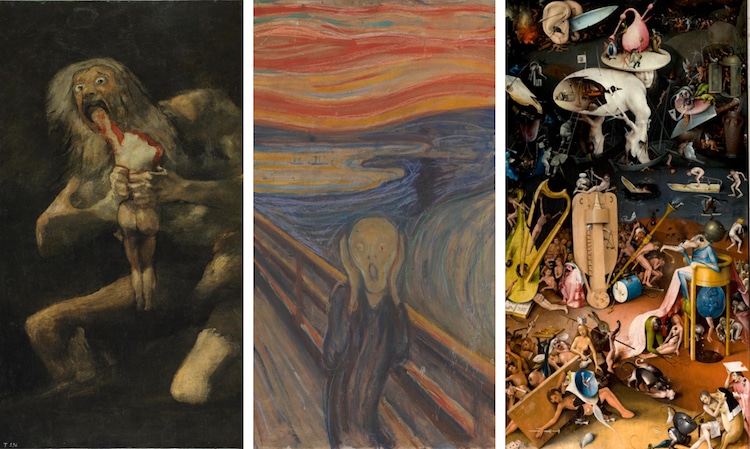
Between 1819 and 1823, the Castilian artist Francisco Goya created his Black Paintings, a series of fourteen particularly haunting pieces. Among the nearly famous of these frightening works of art is Saturn Devouring His Son , a gruesome painting of a begetter feasting on his child.
Co-ordinate to Roman mythology, Saturn (Cronus in Greek sociology) was the leader of the Titans. Saturn overthrew his father, Caelus, in an effort to become ruler of the universe. Fearing his own offspring would practice the same, he killed and consumed each child shortly after birth—an barbarism Goya opted to portray in this Black Painting.
Goya did non create this series for the public. In fact, they were intended to decorate his own home, with Saturn Devouring His Son hanging—where else?—in the dining room.
Biblical Revenge
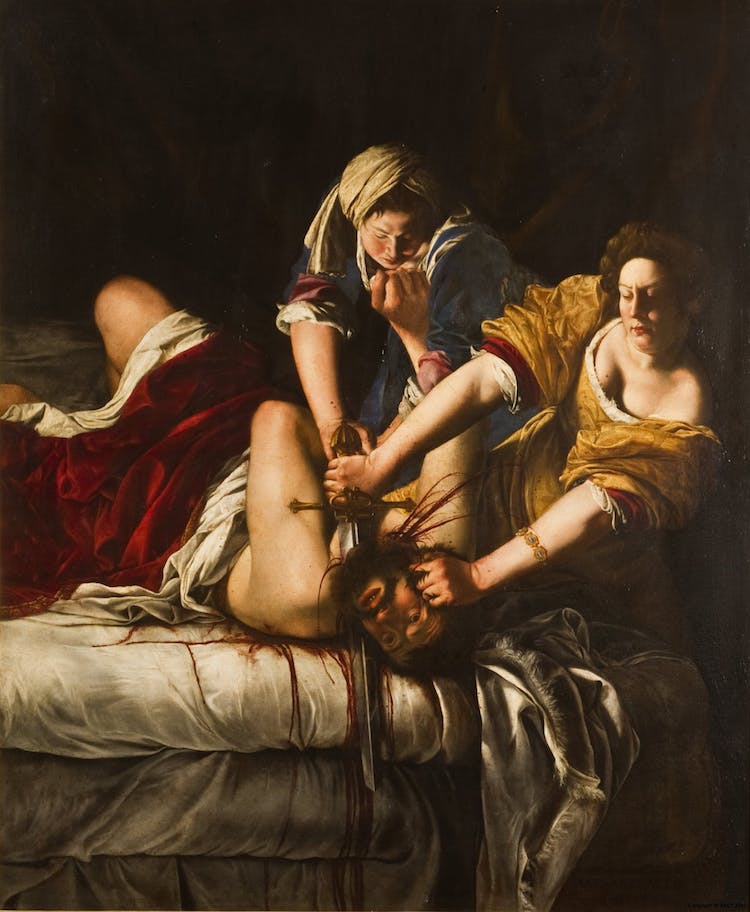
Artemisia Gentileschi, "Judith Slaying Holofernes," 1614–1620 (Photo: Wikimedia Commons, Public domain)
The paintings of Bizarre painter Artemisia Gentileschi are characterized by a deep color palette, a skilled use of light and shadow, and, most prominently, an iconographic focus on suffering female figures seeking—and getting—revenge. A painting that typifies this approach is Judith Slaying Holofernes , a masterpiece inspired by a tale from the Onetime Testament that sees a vengeful widow decapitating a threatening human.
When contextualized (within the context of the bible), Gentileschi'southward determination to portray the gory scene in graphic particular is not especially unusual—specially for drama-loving Bizarre artists. What sets Judith Slaying Holofernes apart from other allegorical paintings of the period, nevertheless, is that Gentileschi most likely snuck a sneaky portrait into the grisly slice, as the slain Holofernes bears a hitting resemblance to Agostino Tassi, a fellow Italian creative person who raped Gentileschi when she was 17 years sometime.
An Electrifying Event
In the early on 1960s, Popular Art founder Andy Warhol pioneered silkscreen painting. Crafted using a combination of acrylic paint and the silkscreen method—a mechanical printmaking procedure in which the artist transferred paintings on canvas onto paper–these works allowed the creative person to translate photographs as multiple, "mass produced" works.
While Warhol's nigh famous silkscreen paintings characteristic pop celebrities and everyday objects as their subjects, his series took a darker plow in 1962, when he started his Death and Disasters serial. Featuring everything from devastating automobile accidents to poisonous cans of tuna to a Large Electric Chair(a painting inspired past a press photograph from the prison where Julius and Ethel Rosenberg were executed), this collection of works speaks to Warhol'due south morbid interest in—and desensitization to— current events.
"When you lot see a gruesome picture over and over again," the creative person said, "it doesn't really have an outcome."
Mysterious Memories
Mexican painter Frida Kahlo is known for her drove of 55 self-portraits. While her most well-known works feature the artist as an developed, she also portrayed herself as a child in Girl with Death Mask (She Plays Lonely) .
This peculiar slice depicts a young daughter standing before a arid landscape. In her hand, she holds a unmarried yellow flower and, on her face, she wears a skull mask. Both of these props are characteristic of Día de los Muertos—or Day of the Expressionless— prompting the viewer to reflect upon themes related to death. Finally, a beastly mask rests at her feet, adding even more than mystery to the chilling painting.
Girl with Death Mask (She Plays Lone) was painted in 1938—the year before her dramatic divorce from fellow artist Diego Rivera. Similar many works created during this time, this piece was likely inspired past Kahlo's feelings of isolation and loneliness. "I paint self-portraits because I am so often alone," the artist famously said, "considering I am the person I know best."
Visited by the Skeleton Specter
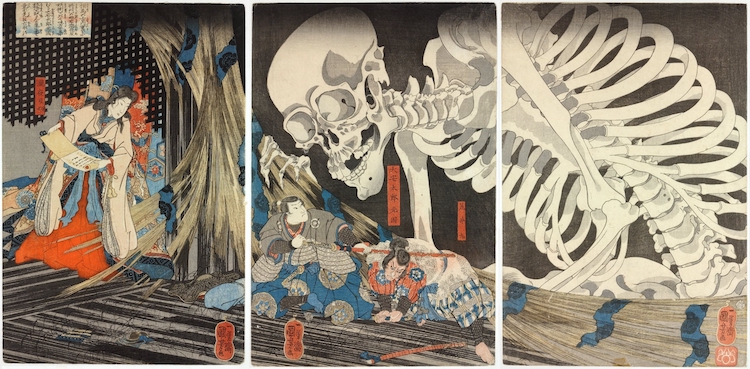
Utagawa Kuniyoshi, "Takiyasha the Witch and the Skeleton Specter" c. 1844 (Photo: Wikimedia Commons, Public domain)
Edo catamenia creative person Utagawa Kuniyoshi created the woodblock print Takiyasha the Witch and the Skeleton Specter, in which a giant skeleton looms over two samurais as a woman reads a scroll in the wings. The unsettling image is based on a story from the Heian period in Japan that took place in 939 CE.
At that time, samurai warlord Taira no Masakado traveled from his habitation in Kantō and led an army to rally against the central government in Kyoto. He eventually tried to set up up an "Eastern Court" in Shimōsa Province but was defeated and decapitated. His girl, Princess Takiyasha, continued to live in the family's shōen, turning to witchcraft and studying dark magic.
Kuniyoshi'southward slice shows her reading a spell to bring forth a Gashadokuro, a spirit that takes the class of a behemothic skeleton. It looks over Ōya Taro Mitsukuni and another samurai who were both sent to get the princess. Their plans were foiled by the haunting spirit.
A Creepy-Awesome Brute
In 1887, French Symbolist artist Odilon Redon created The Smiling Spider , a lithograph of an unusual arachnid with ten legs. Still, even with this extra fix of limbs, the most peculiar thing about this spider is its unsettling grin, which the creative person has delineated with a row of tiny teeth.
The Smiling Spider is i of manynoirs, or "blacks" created past Redon betwixt 1870 and 1890. Rendered in charcoal and as lithographs, these pieces illustrate the creative person'due south involvement in the obscure and, about chiefly, are characterized by darkness—both in colour and field of study matter.
"Black is the most essential color," Redon said. "It conveys the very vitality of a being, his energy, his mind, something of his soul, the reflection of his sensitivity. 1 must respect black. Nothing prostitutes it. Information technology does not please the eye and it awakens no sensuality. It is the agent of the mind far more than the nearly beautiful color of the palette or prism."
A "Scream Passing Through Nature"
Expressionist artist Edvard Munch is renowned for his dark and dreary paintings and prints. From 1893 until 1910, he produced his most famous masterpiece, TheScream , equally a series of four works.
During this 17-year flow, Munch recreated The Scream in crayon, tempera paint, and oil pastel. While the mediums vary from piece-to-piece, each one features the same subject field matter: a mysterious figure continuing on a bridge and holding his face as he screams.
While this scene appears dream-similar, it was really inspired by a real-life location and a particularly frightening phenomenon. "One evening I was walking along a path, the metropolis was on one side and the fjord below," Munch wrote in his diary. "I felt tired and ill. I stopped and looked out over the fjord—the sun was setting, and the clouds turning blood cerise. I sensed a scream passing through nature; it seemed to me that I heard the scream. I painted this moving picture, painted the clouds as bodily blood. The colour shrieked. This became The Scream."
A Bad Dream
Henry Fuseli was a leading effigy of Romanticism, a 19th-century art movement defined by dreamy iconography. In his nigh famous (and aptly named) painting, The Nightmare , Fuseli delves into the scary side of the subconscious.
This spine-tingling work of art shows a sleeping adult female with an incubus—a male demon that preys upon women as they slumber—perched on her body. A ghostly horse emerges from backside a ruby velvet pall, forming the only perceivable role of the blackened groundwork.
About art historians believe that The Nightmare was inspired past High german folktales. According to legend, men who slept alone were visited by equus caballus specters, while lone women were possessed by demons or the devil. By incorporating both of these frightening figures in the composition, Fuseli visually represents the manifestation of a living nightmare.
Death is Victorious
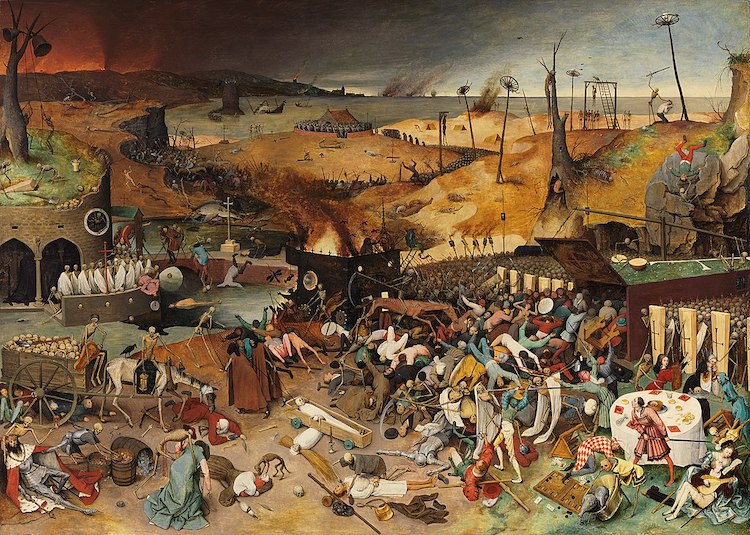
Pieter Bruegel the Elder, "The Triumph of Death" 1562 (Photo: Wikimedia Eatables, Public domain)
For many, few things are scarier than death itself. In Pieter Bruegel the Elder's 1562 paintingThe Triumph of Expiry, an army of skeletons consumes the barren mural that's on fire and absolutely wrecked. The army destroys the living and they accept no chance of achieving conservancy. Highly detailed and gruesome, the slice begs a long look to truly take in the unsettling sights of pure chaos.
This piece was a "moral work" by Bruegel and influenced past the idea of the Trip the light fantastic toe of Decease. Likewise called the Danse Macabre, it'southward based on a medieval creative apologue that decease unites usa all, no matter our station in life.
A Monstrous Beauty
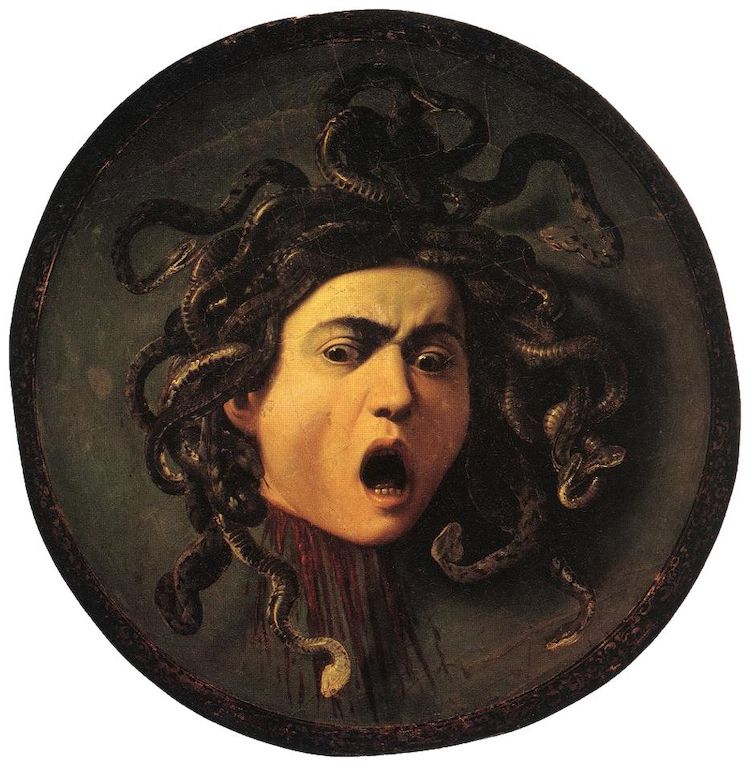
Michelangelo Merisi da Caravaggio, "Medusa," 1597 (Photograph: Wikimedia Eatables, Public domain)
Caravaggio drew on the aboriginal Greek myth of Medusa for this frightening painting. It depicts the severed head of Medusa, a mythical monster who'due south described as a female person adult female with bronze easily and countless venomous snakes for pilus. Legend has it that anyone who even so much as glanced at her would be turned to stone. Medusa was cursed by the Greek goddess Athena, who turned her into the venomous monster she became. Perseus, son of Greek god Zeus and princess Danae, decapitated Medusa using a shield given by Athena.
Caravaggio fabricated two versions of his Medusa painting—one in 1596 and the other in 1597. In this work, Caravaggio used a mirror and painted his own face in the place of Medusa. He did so to indicate his immunity to her terrified expression. Though the head is decapitated, it however appears conscious, capturing Medusa's final horrific moments. Blood pours out from her severed neck, while her mouth hangs wide open, baring teeth.
A Surreal Scene
Though he lived 500 years ago, Hieronymus Bosch remains the master of the macabre. The Early Netherlandish Renaissance creative person is known for his surreal paintings of otherworldly settings—like the fantastic and frightening Garden of Earthly Delights.
While little is known about the origins of this this topsy-turvy triptych, information technology remains Bosch's most resonant works of fine art. Featuring hybrid animals, make-believe machines, and everything in between, the chaotic painting strikes a perfect rest between centre-catching peculiarity and nightmare-inducing horrors—especially when observed in particular.
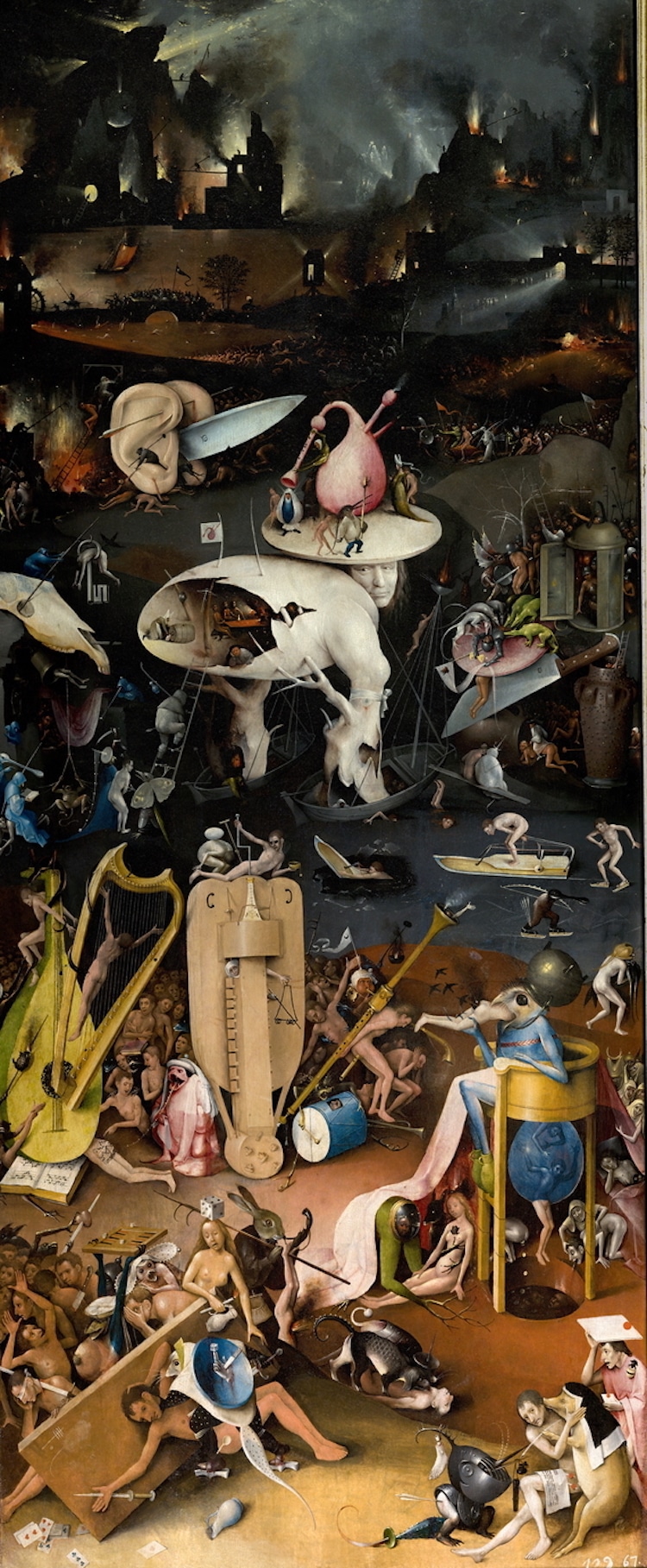
Hieronymus Bosch, "The Garden of Earthly Delights," c. 1500–1505 (Detail)
A whimsical interpretation of the Bible'south Story of Cosmos, the Garden of Earthly Delights proves that any field of study tin be scary if given a surreal twist.
This article has been edited and updated.
Related Manufactures:
28 Frighteningly Fun DIY Kits and Crafts for Halloween
60+ Creative Halloween Makeup Ideas to Inspire Your Side by side Spooky Look
31 Halloween Pumpkin Carving Ideas to Creatively Celebrate the Spookiest Time of Year
Source: https://mymodernmet.com/scary-art/
0 Response to "What Is the Name of Art That Is Gory but Beautiful"
Post a Comment