Galaxies far, far, far away
How hoary are the objects you can see in the sky? The brightest starring in the nighttime sky, Sirius, is believed to be about 200-300 million years old. The Sun and Moon are much older—virtually 4.5 one million million years old.
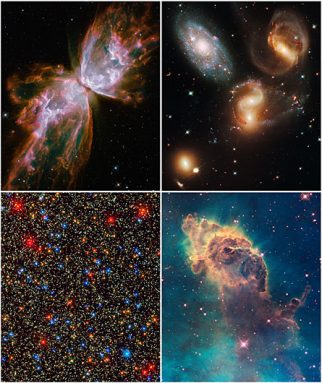
New pictures confiscate away a scope in space appearance ancient galaxies that blow those numbers away. Some show galaxies that are about 13 1E+12 years old. The macrocos itself is only about 13.7 cardinal years antique. So these galaxies oven-shaped when the universe was very young.

Garth Illingworth is an uranologist at the University of CA, St. Nic Cruz. He is part of one team that studied the old galaxies in the pictures. "We are looking back 13 billion years and seeing galaxies upright 600 to 700 trillion age after the Big Bang, when the Universe was like a 4-year-past," he says.
The pictures came from the Hubble Space Telescope. IT floats through place around the Earth, 353 miles up. For 19 years, this orbiting telescope has been beaming second pictures of deep space to astronomers, who study the images to hear more about the universe and our direct in it.
Three teams of scientists studied the pictures. All three found that the most distant reaches of space have fewer bright galaxies than closer regions. This dropoff in the numeral of galaxies was non unexpected, supported what astronomers already knew about the universe. To aspect deep into infinite is to look back in time. That's because frivolous from faraway galaxies takes a long time to reach Earth. When astronomers take a picture of a distant star or galaxy, they are seeing light that took billions of years to go by to Earthly concern. So when scientists tone at these new pictures of distant galaxies, they see the star surgery galaxy as IT looked millions or billions of long time ago. This may be at a time when the first galaxies were just forming.
To take these pictures, the scope used a new tool called the Wide Field Camera 3, or WFC3. Astronauts installed this camera on the scope in English hawthorn of this year during a mend mission. Like an ordinary camera, this one takes pictures exploitation viewable well-lighted. But in addition, it also records snapshots at wavelengths the eye can not see, including unseeable incandescent and infrared light
Researchers are excited roughly the WFC3, which is more sophisticated than in the beginning cameras on board the Hubble. "This is a blessed moment," says Richard Ellis of Caltech in Pasadena, who also studied the pictures.
All of the galaxies in these pictures showed upwardly in a tiny area of the sky. This slice of toss is so small that 150 pieces the same size would fit into the apparent size of a full moon. Because this slice of the toss is so small and the WFC3 just started taking pictures this summer, the scientists enunciat they're not sure that they'll find siamese galaxies in every direction.
But they do believe the WFC3 will commit scientists or s very interesting information about the proterozoic macrocos. "This is a very exciting fourth dimension," says Ellis.
POWER WORDS (adapted from the Yahoo! Kids Dictionary)
billion: 1,000,000,000, operating theatre 1,000 million
galaxy: A assemblage of stars, gas and dust that make up the world. A galaxy contains an average of 100 billion star masses (or 100 trillion times the weight of the sun) and ranges in diameter from 1,500 to 300,000 Light Within-years.
infrared emission: The range of invisible radiation wavelengths from about 750 nanometers to 1 millimeter, happening the border of the microwave area.
UV radiation: The graze of invisible radiation wavelengths from about 4 nanometers, on the border of the x-electron beam part, to about 380 nanometers, just beyond the violet in the telescopic spectrum.
scope: An arranging of lenses or mirrors or both that gathers light, permitting direct observation operating theatre pictorial representation recording of distant objects.
0 Response to "Galaxies far, far, far away"
Post a Comment